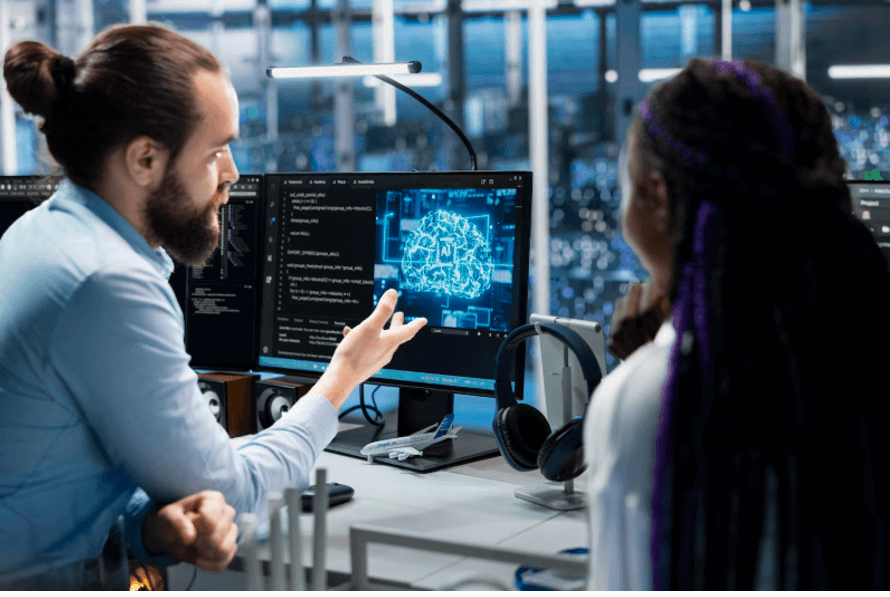
Generative AI has moved beyond experimentation. Businesses across industries are exploring how AI can write content, generate images, analyze data, and automate workflows. The challenge, however, is not the technology itself—it is turning an idea into a functional product that delivers real value.
This is where generative AI development services come in. They help organizations transform early concepts into scalable digital solutions by combining technical expertise, strategic planning, and thoughtful design.
From identifying the right use case to building intuitive interfaces, the journey from concept to product requires a structured approach supported by AI strategy consulting and strong UI design services.
Below is a practical look at how businesses can move from an AI idea to a working product.
Understanding the Real Opportunity Behind Generative AI
Many companies start with excitement around AI but struggle to identify where it truly fits within their operations. Generative AI can support multiple use cases—from automated customer support and personalized marketing to design generation and intelligent document processing.
Before development begins, organizations must evaluate whether AI solves a meaningful business problem. This stage typically involves:
- Identifying processes that require automation or augmentation
- Assessing available data and infrastructure
- Defining measurable outcomes such as productivity gains or cost reduction
This early exploration is where AI strategy consulting becomes critical. Experts help businesses evaluate feasibility, determine the right AI models, and align the initiative with long-term business goals.
Without a clear strategy, even technically advanced AI projects often struggle to deliver practical results.
Step 1: Defining the Product Vision
Once a use case is validated, the next step is translating the idea into a clear product vision.
This stage involves outlining:
- The problem the AI product will solve
- The target users and their needs
- The core capabilities the AI system should provide
For example, a company building an AI-powered content assistant must define whether the tool will generate marketing copy, assist with editing, or automate entire content workflows.
At this stage, teams working in generative AI development services typically produce technical roadmaps, model selection strategies, and early architecture plans. These decisions shape how scalable and reliable the final product will be.
Clarity at this stage prevents costly redesign later in the development process.
Step 2: Choosing the Right AI Models and Infrastructure
Generative AI products rely on large language models, diffusion models, or custom-trained AI systems depending on the application.
Development teams must evaluate several factors when selecting the right technology:
- Model performance and accuracy
- Training requirements and available datasets
- Infrastructure costs and scalability
- Security and data privacy considerations
In many cases, companies combine existing foundation models with custom training to tailor AI outputs to specific industries or workflows.
Experienced providers of generative AI development services also design infrastructure that supports real-time responses, API integrations, and enterprise-grade security. This ensures the AI product can operate reliably as user demand grows.
Step 3: Designing an AI Experience People Can Actually Use
AI products fail when the technology is powerful but the experience is confusing.
This is why UI design services play a central role in AI product development. The interface must help users understand how to interact with the system and interpret AI-generated results.
Key design considerations include:
- Clear prompts and input structures
- Transparent AI responses and explanations
- Feedback loops that allow users to refine results
- Simple workflows that guide non-technical users
Good design removes friction. Instead of forcing users to understand the AI system, the interface adapts to their natural workflow.
When generative AI development services and UI design services work together, the final product becomes both powerful and accessible.
Step 4: Prototyping and Iteration
AI development is rarely a one-step process. Early prototypes allow teams to test functionality, measure accuracy, and identify usability challenges.
During this phase, development teams typically:
- Build minimum viable products (MVPs)
- Test AI outputs using real-world scenarios
- Collect user feedback
- Improve model prompts and workflows
Iteration is especially important in generative AI because output quality improves significantly through testing and prompt engineering.
Companies that invest time in experimentation during this stage often achieve more reliable and practical AI products.
Step 5: Deployment and Scaling
Once the AI product proves reliable, the next challenge is deployment.
Scaling an AI solution involves more than launching the application. Teams must ensure the system performs consistently under real-world usage.
Key considerations include:
- Cloud infrastructure and scalability
- Monitoring AI outputs for quality and bias
- Managing data security and compliance
- Updating models as new data becomes available
Organizations working with generative AI development services often implement monitoring tools that track performance, detect anomalies, and maintain consistent AI behavior over time.
This ensures the AI product continues delivering value as it grows.
Step 6: Continuous Improvement and AI Governance
Generative AI products require ongoing improvement. As user behavior evolves and datasets expand, AI models must adapt.
Companies must also consider governance—ensuring that AI outputs remain accurate, ethical, and aligned with company policies.
Strong AI strategy consulting helps organizations establish frameworks for:
- Responsible AI usage
- Model evaluation and retraining
- Risk management and compliance
- Performance monitoring
AI products are not static tools. They evolve alongside the businesses that use them.
See also: Cannovexa Sapmatrix 8604815999 Reviewplane Axis
FAQs
What are generative AI development services?
Generative AI development services involve designing, building, and deploying AI systems that create new content, data, or insights using machine learning models such as large language models and generative neural networks.
Why is AI strategy consulting important for AI projects?
AI strategy consulting helps businesses identify the right use cases, evaluate feasibility, select appropriate technologies, and align AI initiatives with broader business goals before development begins.
How do UI design services improve AI products?
UI design services make AI systems easier to use by creating intuitive interfaces, clear workflows, and user-friendly interactions that help people understand and refine AI-generated outputs.
How long does it take to develop a generative AI product?
The development timeline depends on project complexity, data availability, and feature requirements. Most generative AI solutions take several months to design, prototype, test, and deploy successfully.
How can businesses get started with generative AI development services?
Businesses should begin by identifying a specific problem AI can solve, evaluating available data, and consulting experts. Working with teams offering generative AI development services and AI strategy consulting helps turn early ideas into scalable, well-designed AI products.